Category: AI Governance | Enterprise Architecture | Risk Management | Digital Transformation
Estimated Reading Time: 10–12 minutes
AI is increasingly being used to support decisions, automate processes, analyze information, improve customer interactions, assist employees, and identify opportunities that would previously have required significant human effort.
But as AI becomes more deeply embedded in the enterprise, the conversation must evolve.
The question is no longer simply:
Where can we use AI? It is also:
How can we use AI responsibly, securely, transparently, and in a way that remains aligned with our business objectives?
In Part 1 of our Transformation Collaboration series, we explored how organizations can connect strategy, people, architecture, governance, and technology to turn AI ambition into execution.
In Part 2, we looked at Business Architecture as the foundation for AI transformation – helping organizations identify the capabilities, value streams, processes, and business outcomes where AI can create meaningful value.
Part 3 takes the next step.
Once an organization understands where AI belongs, it needs a framework for determining how AI should be governed.
At Bizcon, we see AI Governance not as a barrier to innovation, but as an essential part of making AI scalable, trusted, and sustainable.
Key Insight: The objective of AI Governance is not to slow innovation. It is to create the confidence, accountability, and visibility required to scale innovation responsibly.
During the early stages of AI adoption, experimentation is relatively easy to control.
A small team may test an AI assistant. A department may automate a specific activity. Data specialists may develop a predictive model. A proof of concept may operate within a limited environment.
But enterprise adoption is different.
As AI begins interacting with customers, employees, business processes, enterprise information, applications, and decision-making, its impact extends far beyond the technology itself.
Suddenly, what began as a technology initiative becomes an issue involving strategy, architecture, data, security, privacy, risk, compliance, people, and accountability.
This is why organizations need to move from isolated AI experimentation toward enterprise AI governance.
AI Governance is the framework of principles, responsibilities, policies, processes, controls, and decision-making mechanisms used to guide how Artificial Intelligence is selected, developed, acquired, deployed, monitored, and improved.
Its purpose is not simply to establish rules.
Effective AI Governance should help an organization answer practical questions such as:
These questions create accountability. And accountability becomes increasingly important as AI moves closer to critical business operations.
One of the most common mistakes organizations can make is treating governance as something that happens after an AI solution has already been selected or implemented.
At that stage, important design decisions may already have been made.
A stronger approach brings governance into the transformation lifecycle from the beginning.
Before approving an AI initiative, organizations should understand its intended business outcome, affected capabilities, data requirements, architectural dependencies, risk profile, ownership, and expected value.
Governance then becomes part of solution design rather than an approval gate at the end.
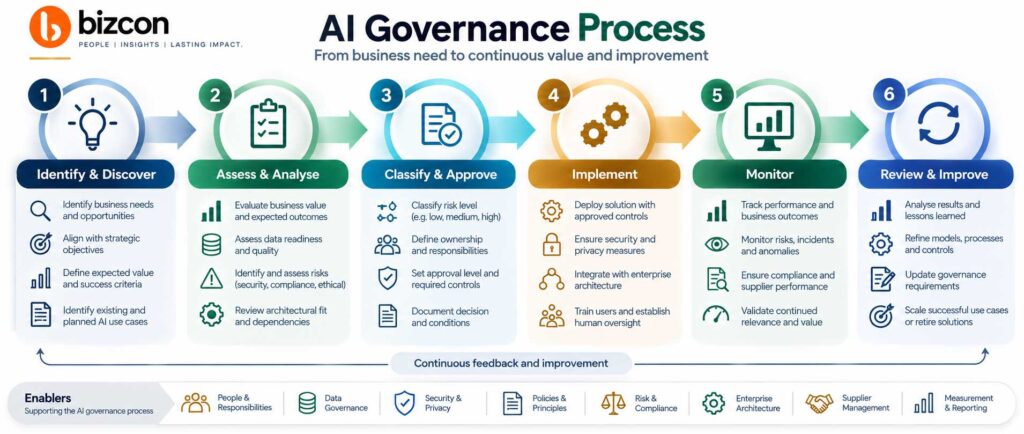
A simple lifecycle can be viewed as:
Business Need → AI Opportunity → Architecture & Data Assessment → Risk Classification → Approval → Implementation → Monitoring → Review & Improvement
This approach helps organizations identify issues while they can still influence the design.
Before organizations can govern AI effectively, they need visibility.
That sounds obvious, but it can become surprisingly difficult.
AI may already exist across the enterprise in SaaS applications, productivity platforms, analytics tools, customer-facing systems, development environments, automation solutions, and services purchased directly by individual departments.
The first practical step toward AI Governance should therefore be creating an AI inventory.
The inventory should provide visibility into the AI use cases and solutions being used or considered across the organization.
But it should go beyond simply recording product names.
For each AI initiative, the organization should understand its business purpose, owner, users, affected capabilities, associated processes, information requirements, supporting applications, external providers, risk classification, governance requirements, and lifecycle status.
This creates an enterprise view of AI adoption.
Without that visibility, governance becomes reactive.
With it, leadership can begin answering a much more useful question:
Where is AI creating value and where is it creating exposure?
Governance should be proportional.
An internal AI tool used to summarize non-sensitive information does not necessarily require the same oversight as an AI system influencing financial decisions, employee-related decisions, customer eligibility, safety, or regulatory obligations.
Treating every AI use case identically can create unnecessary bureaucracy.
Treating every AI use case casually can create unnecessary risk.
The stronger approach is risk-based governance.
Organizations can classify AI initiatives according to factors such as the sensitivity of information involved, potential impact on individuals, degree of automation, business criticality, regulatory exposure, cybersecurity risk, model complexity, third-party dependency, and consequences of incorrect output.
Higher-risk use cases should receive stronger controls, more rigorous validation, clearer accountability, and greater human oversight.
Lower-risk use cases may follow a simpler approval and monitoring process.
This makes governance both practical and scalable.
AI can generate recommendations, identify patterns, automate tasks, and support decisions.
But introducing AI should not make accountability disappear.
One of the most important questions in AI Governance is:
Who remains accountable for the outcome?
If an AI-supported process produces an incorrect result, responsibility cannot simply be transferred to the algorithm.
Organizations need clearly defined ownership.
Business owners should remain accountable for the outcomes of the capabilities and processes in which AI operates.
But responsibility for the business outcome must remain visible.
This is why AI Governance should be an enterprise responsibility rather than an IT- only responsibility.
The phrase “human in the loop” is frequently used in discussions about responsible AI.
But simply adding a human approval step does not automatically create meaningful oversight.
The person reviewing an AI-generated recommendation must understand what they are reviewing, have sufficient information to challenge the result, and possess the authority to override it.
Organizations should therefore determine deliberately where human intervention is necessary.
Some activities may be suitable for full automation.
Others may require human validation.
Higher-impact decisions may require mandatory approval or escalation.
The level of human oversight should reflect the risk and consequence of the decision, not simply the technical capabilities of the AI system.
AI is only as useful as the information environment surrounding it.
Poor-quality, incomplete, outdated, inaccessible, or improperly governed information can undermine even sophisticated AI capabilities.
Organizations therefore need to understand:
This makes Data Governance a fundamental component of AI Governance.
Trusted AI requires trusted information.
And trusted information requires clear ownership, quality standards, classification, access controls, lifecycle management, and appropriate security.
AI Governance without Data Governance creates a significant blind spot.
An AI inventory tells an organization what AI it has.
Enterprise Architecture helps explain where that AI sits within the enterprise and what it affects.
Consider an AI capability used within customer service.
Architecture can connect that AI solution to:
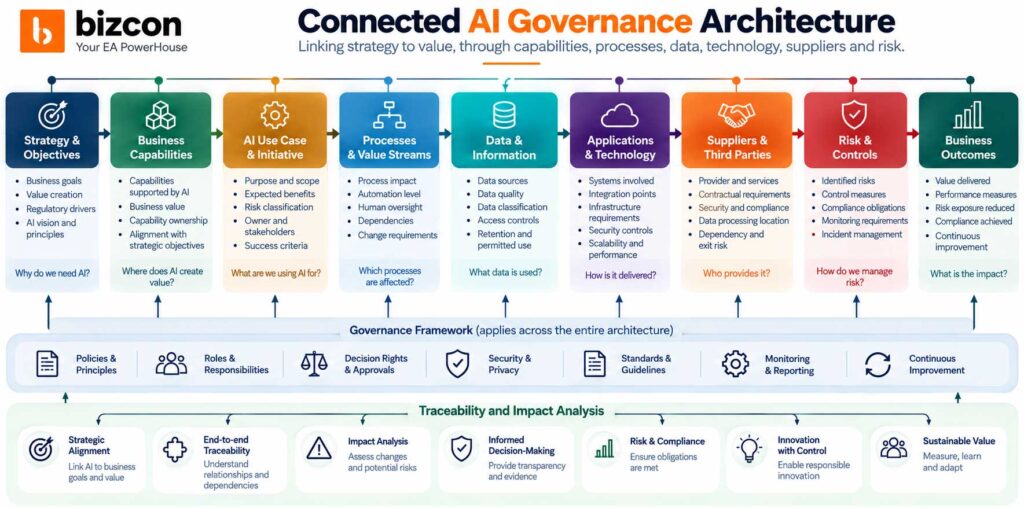
Strategic objectives → Business capabilities → Value streams → Processes → Information → Applications → Technology → Risks → Owners
This creates traceability.
Architecture therefore transforms AI Governance from a collection of policies into a connected enterprise view.
As AI adoption expands, organizations should avoid maintaining separate, disconnected registers for strategy, architecture, risk, applications, suppliers, data, and AI.
The real value comes from connecting them.
Imagine being able to select an AI use case and immediately understand:
That is where Enterprise Architecture and AI Governance converge.
Instead of governance existing primarily in spreadsheets and policy documents, it becomes part of the organization’s transformation architecture.
As AI becomes connected to enterprise applications and information, cybersecurity becomes an increasingly important consideration.
Organizations need to understand what information AI systems can access, how identities and permissions are managed, whether external services process organizational data, how information moves between systems, and what security controls protect those interactions.
AI also introduces new forms of risk that organizations need to consider alongside traditional cybersecurity concerns.
The answer is not simply to block AI.
It is to apply the same disciplined principles used elsewhere in enterprise security:
least privilege, controlled access, information classification, supplier assessment, monitoring, secure configuration, incident management, and clear accountability.
Security should therefore be part of AI architecture from the beginning rather than an additional control added after implementation.
Organizations will not build every AI capability themselves.
Many AI capabilities will enter the enterprise through cloud platforms, SaaS applications, vendors, consultants, APIs, and existing enterprise software.
This means AI Governance must also include supplier governance.
Before adopting an external AI capability, organizations should understand how the provider handles information, where data is processed, whether information is used to train models, which security controls apply, what contractual commitments exist, how incidents are managed, and what happens when the service changes.
Organizations should also consider dependency and exit risk.
If a strategically important capability becomes dependent on a particular AI provider, leadership should understand the implications of that dependency.
This is another area where Enterprise Architecture can provide valuable visibility by connecting suppliers with applications, capabilities, information, and business processes.
Trust is essential for enterprise AI adoption.
Transparency therefore needs to operate at several levels.
Organizations should understand where AI is being used, what it is intended to do, what information it depends on, who is accountable, what limitations exist, and how performance is monitored.
Not every technical model can be explained in complete detail to every stakeholder.
But the business use of AI should always be understandable.
AI Governance does not end when a solution goes live.
Users find new ways of working with technology.
An AI system that was appropriate when introduced may behave differently as its environment changes.
Governance must therefore continue throughout the AI lifecycle.
Organizations should periodically review performance, data quality, security, risks, business value, compliance obligations, incidents, user feedback, and continued strategic relevance.
AI solutions that no longer create sufficient value – or introduce unacceptable risk – should be changed, replaced, or retired.
This creates an important governance principle:
Approval is not permanent.
Governance should support continuous evaluation.
In Part 2, we emphasized that AI success should be measured through business outcomes rather than the number of AI tools deployed.
Part 3 adds another dimension.
Organizations should measure value and risk together.
Leadership therefore needs a balanced view.
Relevant measures might include business performance, adoption, accuracy, process efficiency, customer outcomes, exceptions, incidents, risk indicators, human overrides, compliance findings, and financial value.
This creates a much richer picture of whether an AI capability should be expanded, modified, or reconsidered.
Governance is sometimes viewed as the opposite of speed.
In practice, unclear governance can slow AI adoption considerably.
When responsibilities are uncertain, every new AI initiative creates the same discussions:
A mature governance framework answers many of these questions before individual projects begin.
This allows lower-risk innovation to move quickly while ensuring that higher-risk initiatives receive the scrutiny they require.
Good governance does not remove speed. It removes uncertainty.
For many organizations, the biggest challenge is not writing an AI policy.
It is turning governance into something people can actually use.
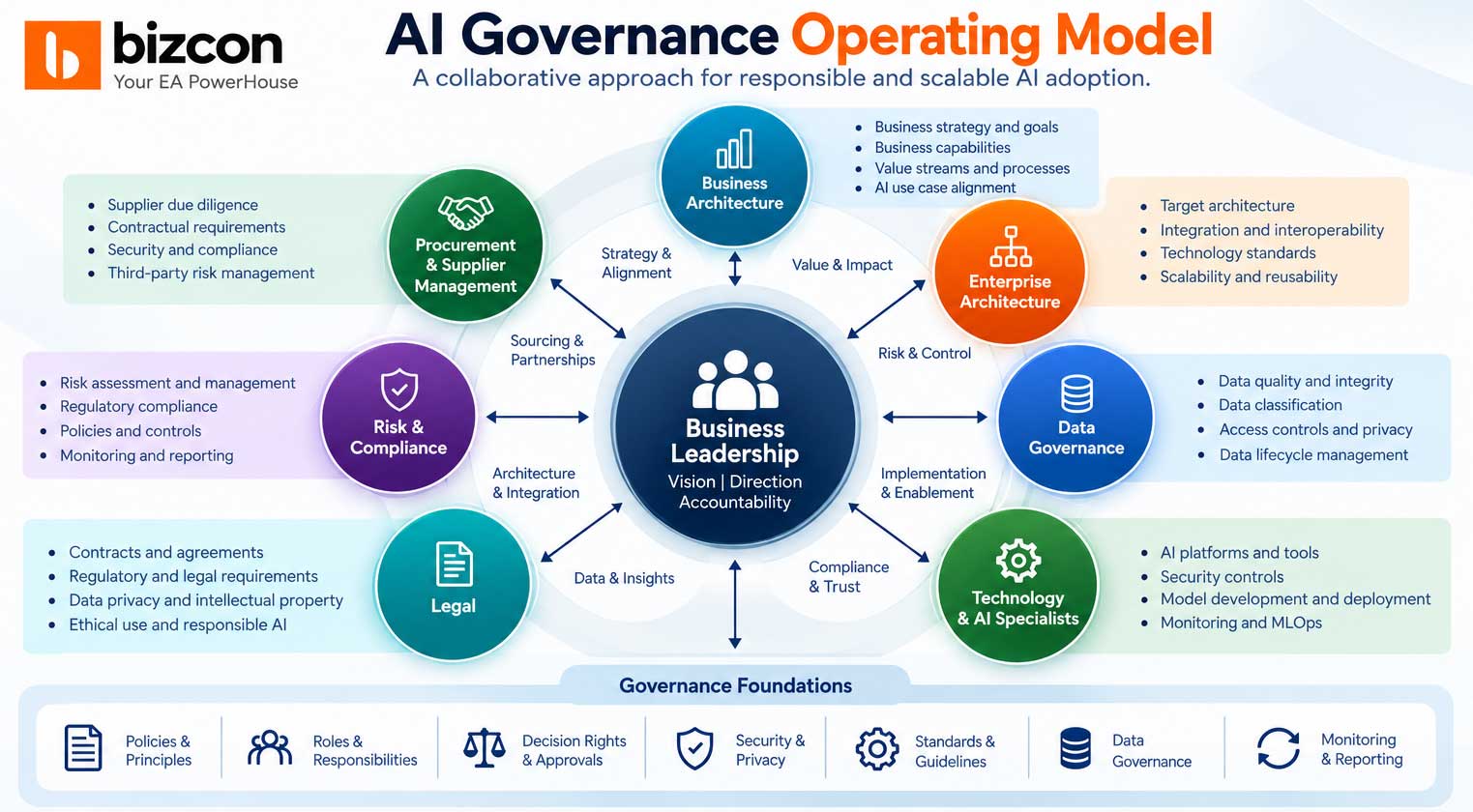
A practical operating model connects leadership, business owners, Enterprise Architecture, IT, data, security, risk, compliance, legal, procurement, and relevant operational teams.
The objective is not necessarily to create a large new governance organization.
Existing governance structures can often be extended.
What matters is establishing clear decision rights and responsibilities throughout the AI lifecycle.
Together, these functions create Transformation Collaboration in practice.
For organizations beginning their governance journey, the model does not need to be unnecessarily complex.
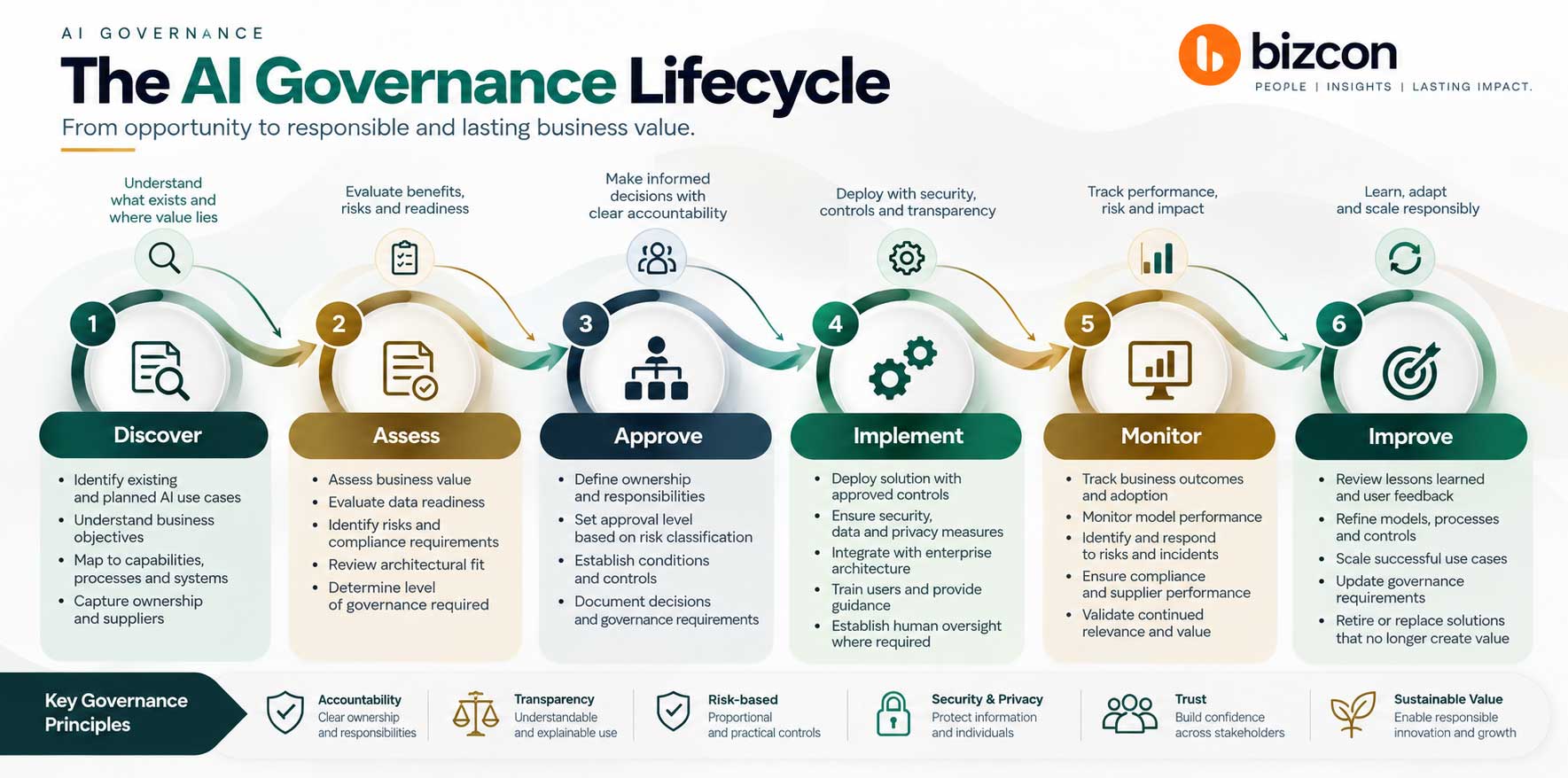
A practical approach can follow six connected stages:
Discover → Assess → Approve → Implement → Monitor → Improve
Discover creates visibility into AI use cases and opportunities.
Assess evaluates business value, architecture, data, security, risk, and compliance.
Approve establishes ownership and determines whether the initiative can proceed and under what conditions.
Implement introduces the solution using appropriate architecture, security, data, and governance requirements.
Monitor tracks business performance, technical performance, risk indicators, incidents, and compliance.
Improve uses those insights to refine, scale, redesign, or retire the capability.
The process is intentionally cyclical.
AI governance is also becoming increasingly important because organizations operate within a rapidly developing regulatory environment.
For organizations operating in or serving the European market, the EU AI Act introduces a risk-based regulatory framework with obligations that vary depending on the type and use of an AI system. Its requirements are being introduced in stages, making it important for organizations to understand which systems they use, their role in relation to those systems, and which obligations may apply.
International standards and frameworks are also helping organizations establish structured approaches to AI management. ISO/IEC 42001 provides requirements for an Artificial Intelligence Management System, while the NIST AI Risk Management Framework provides guidance for managing AI-related risks.
The important point is not to treat compliance as the sole reason for governance.
A well-designed governance framework should support trust, accountability, security, business performance, and responsible innovation at the same time.
AI Governance becomes difficult when information is distributed across spreadsheets, presentations, application inventories, risk registers, supplier records, process models, and individual departments.
Enterprise Architecture platforms can help bring these perspectives together.
Solutions such as Bizzdesign HOPEX, Bizzdesign Horizzon and Bizzdesign Alfabet can support organizations in connecting strategic objectives with capabilities, processes, applications, information, technologies, risks, initiatives, and organizational responsibilities.
For AI transformation, this connected view can help organizations understand how an AI initiative fits into the wider enterprise rather than evaluating it in isolation.
For example, an organization can build traceability between:
AI Initiative → Business Capability → Process → Data → Application → Technology → Supplier → Risk → Control → Business Outcome
This provides a stronger foundation for impact analysis, transformation planning, governance, and executive decision-making.
The goal is not simply to document AI.
The goal is to make its business context, dependencies, risks, ownership, and value visible.
At Bizcon, we believe the organizations that gain sustainable value from AI will be those that connect innovation with architecture and governance.
AI Governance should not sit separately from Business Architecture, Enterprise Architecture, cybersecurity, data governance, risk management, or transformation planning.
These disciplines answer different parts of the same question:
How can we transform the enterprise while protecting the things that matter?
Business Architecture establishes where AI can create value.
Enterprise Architecture shows how AI connects with the wider enterprise.
Data Governance establishes whether the information foundation can be trusted.
Security helps protect systems, information, identities, and interactions.
Risk and compliance establish the boundaries within which AI can operate.
AI Governance connects these perspectives and creates accountability throughout the lifecycle.
When these disciplines work together, organizations can move beyond uncontrolled experimentation without suppressing innovation.
They create an environment where innovation can scale with confidence.
The first three parts of our Transformation Collaboration series establish an important progression.
Part 1: Transformation Collaboration
Connect strategy, people, architecture, governance, and technology.
Part 2: Business Architecture
Understand where transformation and AI can create meaningful business value.
Part 3: AI Governance
Create the trust, accountability, visibility, and controls needed to scale AI responsibly.
But transformation does not stop once governance is established.
The next challenge is ensuring that the enterprise can continue adapting as technologies, markets, customer expectations, regulations, and strategic priorities change.
Organizations therefore need architecture that does more than describe today’s enterprise.
They need architecture that helps them continuously evaluate what should change next.
From Enterprise Architecture to Continuous Transformation: Building an Adaptive Enterprise
In Part 4 of Bizcon Executive Insights, we can explore how organizations can connect strategy, architecture, portfolio management, technology roadmaps, scenario planning, and continuous transformation to create an enterprise that can respond to change without constantly starting transformation programmes from scratch.
Because the ultimate objective is not simply to complete another transformation project.
It is to build an organization that is capable of transforming continuously.