Artificial Intelligence is creating extraordinary opportunities for organizations to improve efficiency, strengthen decision making, enhance customer experiences, and develop entirely new ways of working. Yet as enterprises move beyond experimentation, an important reality is becoming increasingly clear:
Successful AI transformation does not begin with AI. It begins with understanding the business.
In Part 1 of our Transformation Collaboration series, we explored why technology alone cannot deliver transformation. AI initiatives create sustainable value when strategy, architecture, governance, people, processes, data, and technology are aligned around common business outcomes.
In Part 2, we go one level deeper and examine the role of Business Architecture.
At Bizcon, we see Business Architecture as a critical connection between strategic ambition and practical execution. It helps organizations understand what capabilities they need, where value is created, what needs to change, and where technology – including AI – can make the greatest contribution.
Key Insight: Before asking “Where can we use AI?”, organizations should first ask “Which business capabilities and outcomes do we need to improve?”
It is easy for an AI transformation programme to become technology-led.
A new AI capability appears in the market. A department identifies an interesting use case. A proof of concept is launched. Another business unit starts experimenting with a different platform. Before long, the organization may have several AI initiatives underway without a clear enterprise-wide understanding of how they contribute to strategic objectives.
The individual projects may be technically successful, but that does not necessarily mean they are collectively transforming the business.
A business-first approach starts differently.
It begins by understanding the organization’s strategic priorities and translating those priorities into the capabilities, value streams, processes, information, people, and technology required to deliver them.
This allows leadership to ask more meaningful questions:
When these questions come first, AI becomes a strategic enabler rather than an isolated technology investment.
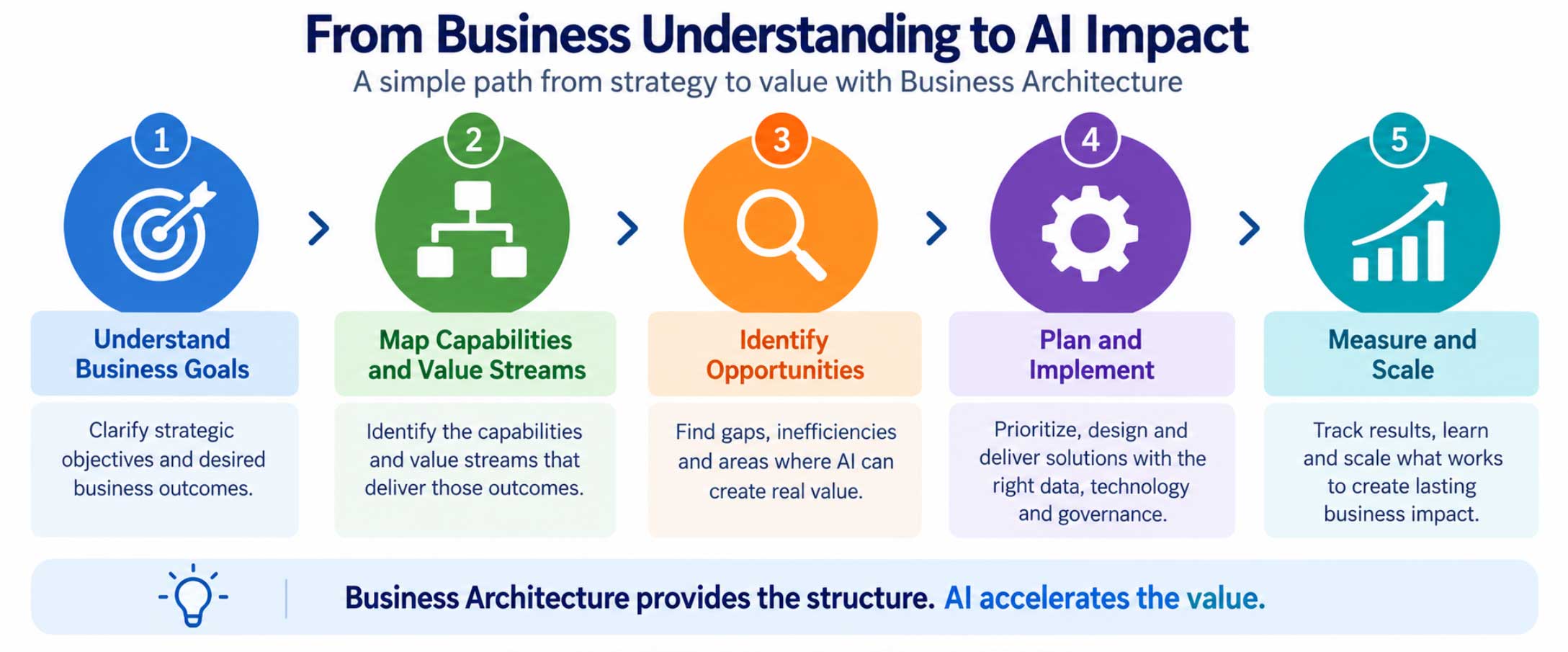
Business Architecture provides a structured representation of how an organization creates and delivers value.
It connects high-level strategy with the practical components required to execute it, including business capabilities, value streams, organizational structures, information, processes, initiatives, and supporting technology.
This creates a common language between executives, business teams, architects, and technology professionals.
Without this common view, strategy can remain abstract. Leadership may know where the organization wants to go, while operational and technology teams struggle to determine exactly what needs to change to get there.
Business Architecture helps close that gap.
For example, if an organization’s strategic objective is to improve customer experience, Business Architecture can help identify which capabilities support that objective, which value streams influence the customer journey, which processes create delays, and which areas may benefit from investment or AI-enabled improvement.
The discussion therefore moves from:
We need more AI. to: We need to strengthen these specific capabilities to achieve this strategic outcome and AI may be one of the ways to do it.
That is a much stronger foundation for transformation.
One of the most powerful elements of Business Architecture is Business Capability Mapping.
A business capability describes what an organization needs to be able to do to achieve its objectives, independent of a particular organizational structure, process, or technology.
Examples might include Customer Management, Product Development, Risk Management, Procurement, Financial Management, Service Delivery, Compliance Management, or Innovation Management.
This distinction is important because technologies change quickly. Organizational structures change. Processes are redesigned. But the fundamental capabilities an organization requires tend to remain more stable.
That makes capabilities a useful anchor for transformation planning.
Instead of beginning with an application or AI product, organizations can evaluate their capabilities and determine:
This creates a much clearer basis for prioritization.
Business capabilities help organizations decide where transformation matters most before deciding which technology to implement.
A capability map provides an enterprise-wide view of what the organization does.
When additional information is connected to those capabilities such as strategic importance, performance, cost, risk, applications, processes, data, and planned investments – the map becomes much more than an architecture diagram.
It becomes a decision-making instrument.
Imagine that leadership wants to improve operational efficiency through AI.
Without a capability view, individual departments may independently propose dozens of automation opportunities.
With a capability map, leadership can instead identify capabilities that are strategically important but currently underperforming. The organization can then investigate which processes, applications, information assets, and organizational dependencies contribute to that performance.
AI investments can subsequently be targeted toward the areas where they have the greatest potential impact.
This reduces the risk of investing in AI simply because a use case is technically interesting.
Capabilities explain what the organization must be able to do.
Value streams help explain how value is delivered to a customer, stakeholder, partner, or other beneficiary.
This is particularly important for AI transformation because customers do not experience individual departments, systems, or architecture domains. They experience an end-to-end journey.
Consider customer onboarding.
From the customer’s perspective, it may be one experience. Internally, however, it could involve sales, identity verification, compliance, finance, customer service, several applications, multiple datasets, and numerous manual approvals.
Automating one activity may improve one department while doing very little for the overall customer journey.
A value-stream perspective encourages organizations to examine the complete flow of value.
By combining value streams with capability mapping, organizations gain a much stronger understanding of where transformation can create measurable value.
AI and intelligent automation make it possible to accelerate many activities.
But speed is not always the same as improvement.
If an existing process contains unnecessary approvals, duplicated activities, unclear responsibilities, or poor-quality information, applying AI may simply make an inefficient process operate faster.
Before automation, organizations should therefore ask whether the process itself should be simplified, redesigned, standardized, or even eliminated.
Business Architecture provides the context for making that decision.
It helps organizations understand how a process contributes to a broader capability and value stream rather than optimizing an isolated activity without considering its purpose.
The objective should not be to automate everything possible. The objective should be to improve how the organization creates value.
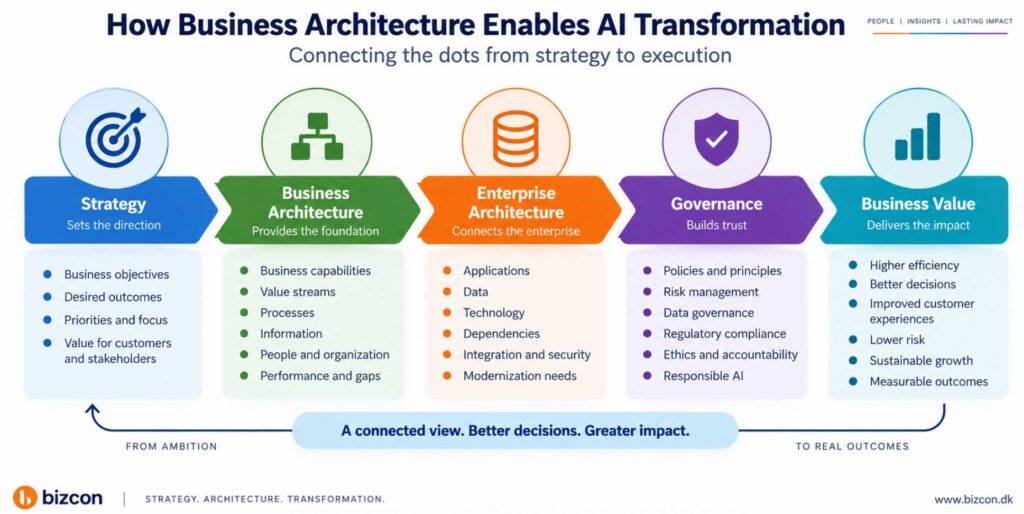
Business Architecture becomes even more powerful when connected with Enterprise Architecture.
Business Architecture establishes the business context:
Enterprise Architecture extends that understanding into the wider enterprise landscape:
Together, these disciplines create traceability from strategy to execution.
A simplified transformation chain might look like:
Strategic Objective → Business Outcome → Business Capability → Value Stream → Process → Information → Application → Technology → Transformation Initiative
AI can then be introduced at the appropriate points in this chain rather than sitting outside it as an independent programme.
This is particularly valuable when organizations are managing multiple transformation initiatives simultaneously.
AI requires context to create meaningful business value.
Consider an AI solution designed to improve decision-making. The model may be technically sophisticated, but the organization still needs to understand
Business Architecture helps establish that context.
It connects AI initiatives with the capabilities, processes, stakeholders, information, policies, and outcomes surrounding them.
This makes it easier to determine where AI should augment human decision-making, where automation is appropriate, and where stronger oversight may be required.
It also improves conversations between business and technology teams. Instead of discussing AI primarily in technical terms, stakeholders can discuss its effect on business performance.
Transformation requires an understanding of two things:
Where are we today? and Where do we want to be?
Business Architecture helps organizations establish both perspectives.
The current state provides visibility into existing capabilities, processes, organizational responsibilities, pain points, information flows, and dependencies.
The future state describes how those elements should evolve to support strategic objectives.
The difference between the two reveals the transformation gap.
For example, an organization may determine that a strategically important capability currently relies heavily on manual processing, fragmented information, and several legacy applications.
Its future state vision might include standardized processes, trusted enterprise data, intelligent automation, AI-supported decisions, and a simplified application landscape.
The organization now has a defined business reason for transformation rather than a generic ambition to “adopt AI.”
A future state architecture is valuable only if the organization can realistically reach it. This is where transformation roadmapping becomes critical.
Not every capability can be improved simultaneously. Not every application can be modernized at once. And not every AI opportunity deserves immediate investment.
Organizations must consider business value, strategic importance, cost, risk, dependencies, organizational readiness, data availability, regulatory requirements, and implementation complexity.
A practical roadmap may therefore sequence transformation initiatives so that foundational capabilities are established before more advanced AI initiatives are scaled.
For example:
Strategy and capability assessment → Process improvement → Data readiness → Architecture modernization → AI enablement → Governance → Measurement and continuous improvement
This sequencing helps organizations avoid one of the most common transformation mistakes: introducing advanced technology before the underlying business environment is ready to support it.
Transformation frequently crosses organizational boundaries.
A customer experience initiative may involve sales, marketing, operations, finance, IT, legal, security, and data teams.
If every department views the initiative only from its own perspective, priorities can conflict and dependencies can be overlooked.
It replaces isolated decision-making with coordinated enterprise planning.
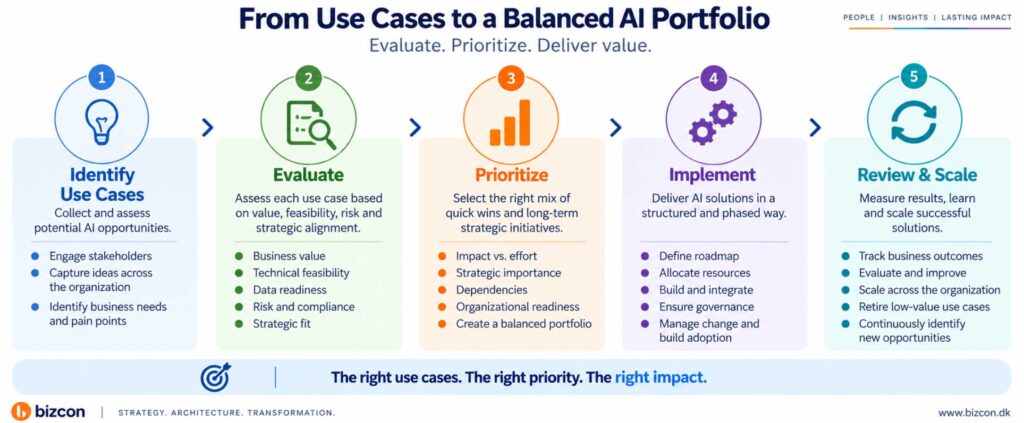
As AI adoption grows, organizations may quickly accumulate dozens or even hundreds of potential use cases.
Not all of them should be implemented.
Business Architecture provides a structured basis for evaluating and prioritizing these opportunities.
Instead of prioritizing solely according to technical feasibility, organizations can evaluate each initiative according to factors such as strategic alignment, capability impact, customer value, financial benefit, risk, data readiness, implementation complexity, and scalability.
This helps create a balanced AI transformation portfolio.
Some initiatives may offer quick operational improvements.
Others may strengthen strategically important capabilities over several years.
Some may be technically possible but offer limited business value.
And some may need to wait until data, architecture, or governance foundations have matured.
This portfolio perspective helps leadership invest intentionally rather than reactively.
Business Architecture also creates a foundation for measuring transformation.
If an AI initiative has been connected to a strategic objective and business capability from the beginning, organizations can establish meaningful performance indicators before implementation.
Instead of measuring only technical activity such as the number of AI models deployed or users onboarded the organization can measure actual outcomes.
Depending on the capability, these could include reduced processing time, improved customer satisfaction, lower operational cost, increased quality, faster decision-making, reduced risk, improved employee productivity, or stronger regulatory compliance.
This creates an important shift:
AI success is measured by capability improvement and business outcomes – not by AI adoption alone.
At Bizcon, we believe Business Architecture provides the missing foundation between AI ambition and sustainable transformation.
Organizations do not need AI everywhere. They need clarity about where AI can create meaningful value, what must change around it, and how that change contributes to strategic objectives.
Our approach starts by helping organizations understand their strategic priorities, business capabilities, value streams, processes, information, and dependencies. Enterprise Architecture then connects this business perspective with applications, data, technology, governance, and transformation initiatives.
Using leading platforms such as Bizzdesign and HOPEX, organizations can establish a shared architectural view that improves transparency and supports more informed transformation decisions.
The objective is not to create more architecture documentation.
The objective is to make architecture useful for decision making.
When leadership can see the relationship between strategy, capabilities, investments, technology, and business outcomes, transformation becomes easier to prioritize, govern, communicate, and measure.
Business Architecture answers an essential question:
Where should we transform?
But as AI becomes embedded in important business capabilities and decision-making processes, organizations must answer another equally important question:
How do we transform responsibly?
AI introduces considerations around accountability, transparency, data quality, privacy, security, regulatory requirements, risk, and human oversight.
These issues cannot be addressed after implementation.
They need to become part of the transformation architecture from the beginning.
That brings us to the next stage of the Transformation Collaboration journey.

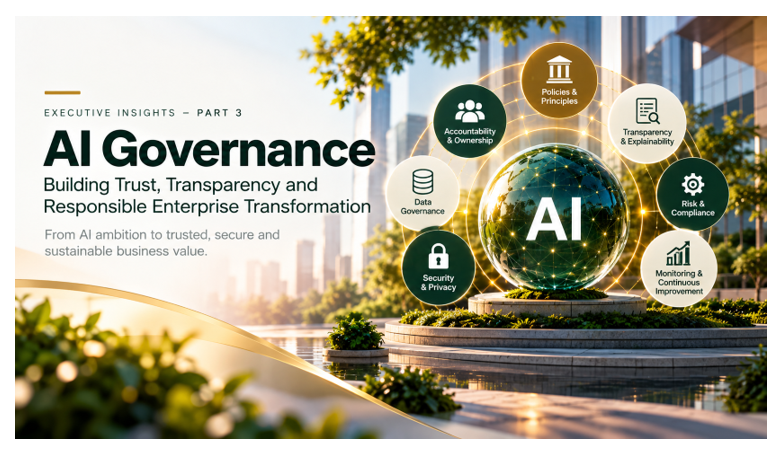
AI Governance: Building Trust, Transparency, and Responsible Enterprise Transformation
In Part 3 of Bizcon Executive Insights, we explore how organizations can move from AI experimentation toward trusted enterprise adoption by connecting AI Governance, Enterprise Architecture, risk management, data governance, and business accountability.
Because successful AI transformation is not only about determining where AI can create value.
It is also about ensuring that value can be delivered responsibly, transparently, and sustainably.
Start with the business problem, understand the capability, follow the value, and then determine where AI belongs.
When organizations reverse this order and begin with technology, they risk creating solutions in search of problems. When Business Architecture comes first, AI becomes part of a deliberate transformation strategy – one that connects investment directly to business value.