Enterprise Architecture Solutions Deep Dive

Enterprise Architecture (EA) solutions help organizations see the big picture, connecting strategy, capabilities, processes, applications, data, and risk into a single source of truth. With the fit-for-purpose IT solution, organizations can move beyond siloed knowledge to traceable decisions that optimize spending, reduce risk, and speed up transformation.

Bizzdesign now offers a comprehensive EA portfolio with three leading IT platforms:

  • Horizzon – strategy-to-execution with powerful visualization.
  • Hopex – compliance-heavy EA with governance and risk integration.
  • Alfabet – IT portfolio and cost optimization with lifecycle management.

This newsletter dives deep into each platform, explaining strengths, trade-offs, and use cases plus practical advice on how to choose and implement successfully.

Highlights

  • Strategic Focus & Use Case Match
  • Which solution is strongest depending on whether your top needs are visualization & strategy alignment Horizzon, risk & compliance + process governance & business continuity management Hopex, or IT portfolio rationalization & cost optimization Alfabet.
  • Core Capabilities Comparison
  • We’ll compare modeling standards (ArchiMate, BPMN, etc.), dashboarding & scenario planning, compliance & controls, lifecycle & application portfolio management.
  • Implementation Practicalities
  • Deployment complexity, required governance & stewardship, integration with existing IT solutions (CMDB, ITSM), how to avoid common pitfalls like over-modeling or stale data.
  • Demo Checklist You Should Use
  • A set of questions to ask during vendor demos or RFPs, to ensure you don’t just see “pretty diagrams” but get measurable value.

Why This Matters

The right EA solution influences:

  • Cloud migrations & modernization: assessing risks, dependencies, and transformation paths.
  • Regulatory compliance: ensuring traceability of risks and controls.
  • Digital transformation planning: mapping business strategy to capabilities and systems.
  • Mergers & acquisitions: integrating applications, processes, and data landscapes faster.
  • Cost optimization: cutting redundant applications and managing technical debt.

EA solutions are no longer just modeling repositories, they are strategic decision platforms for executives, CIOs, and architects.
Bizzdesign Horizzon – strategy to execution with strong visualization and ArchiMate support

Bizzdesign provides a cloud-first EA and business-design platform that emphasizes collaboration, visualization, and ArchiMate-based modeling across strategy, capabilities, processes, applications and technology. It’s marketed as a solution to connect strategy and execution with powerful scenario and roadmap visualizations.

Core capabilities

  • Standards-based modeling: Native ArchiMate support, plus BPMN/UML/ERD where needed.
  • Strategy-to-execution tooling: Strategy maps, capability maps, heatmaps, roadmaps and scenario planning to evaluate change options.
  • Analytics & dashboards: Self-service analytics, heatmaps and embedded BI for stakeholder reporting.
  • Collaboration & governance: Central repository with role views and access control for architects, product owners and executives.

Typical use cases

  • Aligning digital initiatives to strategy (strategy-on-a-page + capability mapping).
  • Application portfolio management with visual impact analysis.
  • Scenario planning for cloud migration or consolidation programs.

Purpose / Strengths

Horizzon’s biggest strength lies in connecting strategy to execution. It is designed for organizations that want to clearly visualize the link between business goals, capabilities, processes, and the underlying IT landscape.
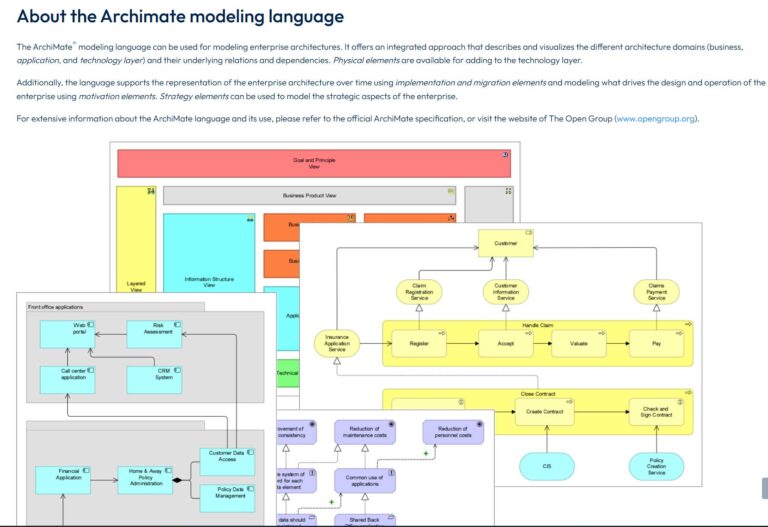
  • It offers native ArchiMate support, making it one of the most comprehensive solutions for business and enterprise modeling.
  • Stakeholder friendly storytelling features ensure that executives and non-technical teams can interpret roadmaps and strategy pages without needing to understand modeling notations.

Core Modeling & Standards

  • Supports multiple standards including ArchiMate, BPMN, UML, and ERD, enabling flexibility across business and IT layers.
  • Strong business capability mapping lets organizations map strategic capabilities directly to enabling applications, people, and technologies – a critical factor in aligning transformation initiatives.

Scenario & Roadmapping Features

  • Offers strategy maps, capability maps, and impact analysis views that help teams visualize dependencies and risks.
  • What-if scenario planning enables organizations to explore options before committing – for example, comparing different cloud migration strategies or understanding the downstream impact of retiring a core application.

Governance & Compliance Integration

  • Provides role-based governance views, allowing different stakeholders to see only the perspectives relevant to them.
  • However, Horizzon is less specialized in risk/control management compared to Hopex, so enterprises with deep compliance requirements may need complementary solutions.

IT Portfolio / Application Lifecycle

  • Very strong at impact visualization – you can quickly see how a change in one system affects processes, capabilities, or even strategic goals.
  • Good for application portfolio management use cases, though less focused on cost/financials than Alfabet.

Data / Integration Needs

  • Offers flexible dashboards, BI integration, and connectors for external data sources.
  • The Horizzon solution is most effective when reliable source data is available, as incomplete or inconsistent inputs can limit the quality of insights.

Ease of Use & Adoption

  • Designed with visualization-first principles, which reduces the learning curve.
  • Teams can get started fairly quickly, often using pilot use cases like application portfolio management or capability planning before scaling up.

Typical Organizations

  • Best suited for mid-to-large enterprises undergoing transformation programs.
  • Works well in organizations that are moderately regulated or less burdened by compliance-heavy requirements, where speed and visualization matter more than deep GRC coverage.

Bizzdesign Hopex – integrated EA, BPM, BCM + GRC

Hopex is a platform designed to unify enterprise architecture, data architecture, business process analysis, business continuity management, governance, risk & compliance (GRC) and data governance in a single repository. It’s often chosen by regulated, medium to large scale enterprises that need traceability between risk, compliance and architecture.

Core capabilities

  • Unified repository: Single source of truth for EA artifacts, processes, risks, controls and data assets. 
  • GRC integration: Risk registers, control mapping, compliance workflows and audit support tied to architecture. 
  • Process & capability modeling: BPMN support, process mining connectors and business-process to IT mapping.
  • Automation & analytics: Automated discovery, analytics dashboards, and AI/automation features in recent releases. 

Typical use cases

  • Regulated industries (banking, insurance, public sector) where linking compliance to architecture is required.
  • Enterprise-wide governance programs that must show controls, risk treatment and architecture impact together.

Purpose / Strengths

Hopex is designed to integrate Enterprise Architecture (EA), Governance, Risk & Compliance (GRC), and Business Process Management (BPM) in a unified platform. Its strength lies in compliance and regulated environments, where traceability between risks, controls, and architecture is critical.

  • Strong risk and compliance features make it especially valuable for industries like banking, insurance, and government.
  • A single repository ensures that business processes, risks, and IT architecture are always connected, enabling consistent governance.

Core Modeling & Standards

  • Supports BPMN and process mining, making it strong for organizations that rely on process optimization.
  • Offers controls/risk models alongside traditional EA models, bridging the gap between architecture and compliance.
  • Can map business processes to IT systems and data assets, showing how compliance or operational risks affect IT and business simultaneously.

Scenario & Road mapping Features

  • Provides moderate scenario planning capabilities, with a focus on understanding compliance impacts.
  • Hopex scenarios are often about business continuity, regulatory or risk-driven changes (e.g., GDPR/Privacy Management compliance impact).

Governance & Compliance Integration

  • One of Hopex’s strong areas – with control libraries, audit trails, compliance workflows, and risk/control mapping.
  • Enables organizations to connect business continuity and regulatory requirements directly to architecture, ensuring that compliance gaps are traceable to systems and processes.

IT Portfolio / Application Lifecycle

  • Provides solid application portfolio capabilities, with a focus on data assets and process mapping.
  • Strong at showing how processes and risks are tied to IT systems.

Data / Integration Needs

  • Offers a wide integration landscape, especially for compliance, governance, and regulatory reporting.
  • Built-in data governance ensures quality and consistency in repositories.

Ease of Use & Adoption

  • Significant out-of-the-box wider meta-model than Horizzon or Alfabet.
  • Recommends governance roles (e.g., compliance stewards, process owners) to keep the repository clean and reliable.

Typical Organizations

  • Regulated enterprises in sectors like finance, insurance, healthcare, and public administration.
  • Organizations that must prove compliance traceability to auditors and regulators.

Bizzdesign Alfabet – IT portfolio & investment planning first, EA-enabled

Alfabet focuses on IT portfolio management, application portfolio management (APM) and strategic planning for IT investments. It blends EA concepts with portfolio and project planning to help organizations reduce IT cost, manage technical debt and plan large-scale transformation programs.

Core capabilities

  • IT portfolio & application lifecycle management: Inventory of applications, lifecycle states, technical debt, costs and business fit.
  • Strategic portfolio planning: What-to-invest/what-to-retire decisions, scenario planning for transformations, and investment optimization. 
  • Integration with process & project tools: Connects EA insights to project portfolios and change programs to quantify risk & impact. 

Typical use cases

  • Organizations with large, aging application landscapes seeking cost reduction and rationalization.
  • CIOs who need transparent IT investment planning tied to business capabilities and project pipelines.

Purpose / Strengths

Alfabet is designed for IT portfolio management, application lifecycle tracking, and investment planning. Its strength is in cost optimization and rationalization of large application landscapes.


  • Favored by CIOs for financial transparency and technical debt reduction.
  • Strong alignment between investment decisions and business capabilities.

Core Modeling & Standards

  • Focuses on application inventory, lifecycle stages, and technical debt metrics.
  • Less modeling-intensive, more metrics- and portfolio-driven.

Scenario & Road mapping Features

  • Strong in retire vs. modernize decision-making.
  • Provides investment vs. cost trade-offs for large-scale transformations.

Governance & Compliance Integration

  • Solid for IT cost/risk tracking.
  • Less specialized in compliance compared to Hopex.

IT Portfolio / Application Lifecycle

  • Alfabet’s strong area: lifecycle, modernization paths, cost tracking, and retirement planning.
  • Supports CIO decision-making on application rationalization.

Data / Integration Needs

  • Rich connectors to financial systems, CMDBs, ERP, and PPM.
  • Effective when linked with ITSM and ERP for real-time financial insights.

Ease of Use & Adoption

  • Medium complexity — requires solid inventory data to be useful.
  • Unlocks value once application and cost inventories are in place.

Typical Organizations

  • Large enterprises with thousands of applications.
  • Companies aiming to cut IT spend and prioritize modernization.

How to choose – practical checklist for procurement & pilots

  1. Start with business outcomes. Map 2–3 measurable outcomes (e.g. reduce application costs 20% in 18 months; complete cloud migration impact analysis for top 200 apps) – match these outcomes to vendor strengths.
  2. Data readiness: Do you have an inventory (apps, tech, processes) or will you need discovery & workshops? Alfabet favors organizations with existing IT inventory work.
  3. Governance & roles: Hopex recommends governance cadence to keep GRC/controls updated — plan for stewardship roles if you choose it.
  4. Integration needs: Confirm connectors (CMDB, ITSM, project portfolio tools, discovery tools) and vendor APIs.
  5. Pilot scope: Pick a high-impact slice and measure ROI.

Implementation tips – increase your chance of success

  • Define minimal viable repository: avoid the “tyranny of everything.” Start with prioritized asset classes and expand.
  • Data governance and stewardship: assign owners for application, capability and process metadata. Hopex users frequently formalize this early.
  • Executive dashboards: build 2–3 executive-level views that answer their questions (cost, risk, roadmap). Horizzon visualization toolkit is useful here.
  • Integrate discovery & CMDB: automate population where possible to reduce manual effort; Alfabet, Horrizzon and Hopex have discovery/connectors to help.

Risks & common pitfalls

  • Over-modeling: capturing every detail kills adoption – prioritize decisions the solution must inform.
  • EA solution as a repository, not a discipline: EA solutions don’t fix culture; success needs processes, roles and governance.
  • Neglecting integrations: without sync to CMDB/ITSM/PjM tools, the repository becomes stale.

Where to learn more

  • Horizzon – official platform & ArchiMate help. Good for product pages, platform overview and ArchiMate guidance. Bizzdesign Horizzon
  • Hopex – product & GRC pages. Official Hopex platform and GRC/function pages explain unified governance approach. Bizzdesign Hopex
  • Alfabet – Alfabet product pages & SPM documentation. Focused on IT portfolio, investment planning and APM. Bizzdesign Alfabet

Final Recommendations

  • If your priority is strategy visualization, storytelling, and capability mapping → choose Horizzon.
  • If your challenge is business process management, continuity management or compliance, risk, and governance in a regulated environment → choose Hopex.
  • If you need IT cost optimization, rationalization, and lifecycle planning → choose Alfabet.

Together, Bizzdesign’s Horizzon, Hopex, and Alfabet provide one of the broadest EA solution portfolios in the market – enabling organizations to balance strategy, compliance, and cost optimization in a single ecosystem.