Category: Executive Insights | Enterprise Architecture
Estimated Reading Time: 12–15 minutes
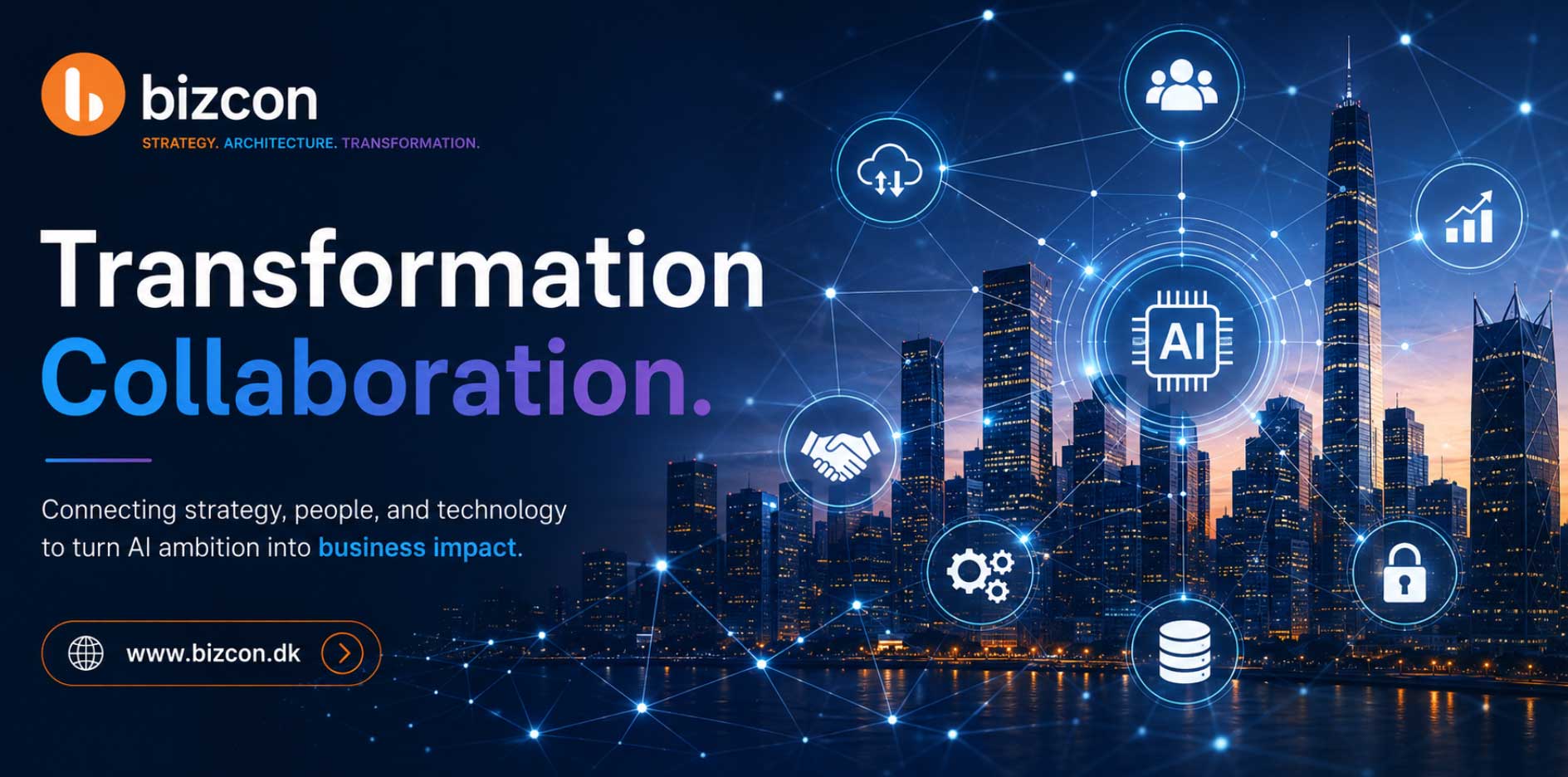
Executive Insights | Part 4 – Transformation Collaboration Series
How organizations can connect strategy, business capabilities, Enterprise Architecture, AI, and portfolio decisions to build resilience, accelerate innovation, and enable continuous business transformation.
The Next Challenge: Moving Beyond Individual Transformation Projects
For many organizations, transformation has traditionally been managed as a series of projects.
A new technology platform is introduced. A business process is redesigned. An application is replaced. An AI solution is implemented. Once the initiative is completed, attention shifts to the next priority.
But the business environment rarely stands still.
Customer expectations evolve, emerging technologies create new opportunities, regulatory requirements change, and competitive pressures demand faster responses.
In this environment, transformation cannot be treated as an occasional activity with a defined beginning and end.
It must become a continuous organizational capability.
This shift requires organizations to move beyond isolated projects and establish a connected approach to strategy, business architecture, technology investments, governance, and operational improvement.
Enterprise Architecture plays a central role in enabling this transition.
Rather than functioning primarily as a documentation discipline, Enterprise Architecture can provide the visibility, structure, and decision support needed to continuously align business priorities with organizational capabilities and technology investments.
The result is an adaptive enterprise – an organization capable of responding to change without losing strategic direction, operational control, or architectural consistency.
Key Insight: The future of enterprise transformation is not defined by how many initiatives an organization delivers, but by how effectively it can continuously adapt its capabilities, processes, technology, and investments to changing business needs.
Many transformation programs begin with clear strategic objectives but become increasingly fragmented during execution.
Different departments initiate their own improvements. Technology teams introduce new solutions. Business units adopt AI tools. Existing applications are extended, replaced, or integrated.
Each initiative may deliver local benefits, but the overall enterprise can become more complex.
Common challenges include:
The challenge is not necessarily a lack of transformation activity.
It is often the absence of a connected mechanism for coordinating transformation across the organization.
Transformation without architectural alignment can increase complexity faster than it creates value.
To address this, organizations need an approach that connects strategic direction with the capabilities, processes, information, applications, and technologies required to execute it.
Enterprise Architecture provides a structured understanding of how an organization operates and how its different components work together.
It connects business objectives with business capabilities, value streams, processes, information, applications, technology, and governance.
Traditionally, Enterprise Architecture has often been associated with documenting the current environment and defining a future target architecture.
While these activities remain important, an adaptive enterprise requires a more dynamic approach.
Enterprise Architecture must support ongoing decisions.
This includes helping organizations understand:
The objective is not to create a perfect architectural model.
It is to maintain a sufficiently accurate and connected view of the enterprise to support better decisions.
From static documentation to decision intelligence
A modern Enterprise Architecture practice should help decision-makers move from asking:
“What does our architecture look like?”
to asking:
“What should we change, why should we change it, and what will the impact be?”
This shift transforms Enterprise Architecture from a primarily descriptive discipline into a practical foundation for continuous transformation.
Technologies change. Organizational structures evolve. Business processes are redesigned.
Business capabilities, however, provide a relatively stable way to understand what an organization must be able to do to deliver value.
Examples include customer management, financial reporting, supplier management, product development, risk management, and service delivery.
By mapping and assessing business capabilities, organizations can identify where transformation is most valuable.
Capability-based transformation enables organizations to:
Identify strategic priorities
Understand which capabilities are most important for achieving business objectives.
Assess current performance
Evaluate capability maturity, effectiveness, risks, and improvement opportunities.
Connect investments to business needs
Prioritize technology, process, data, and AI initiatives based on the capabilities they support.
Understand dependencies
Identify the processes, applications, information, people, and suppliers required to deliver each capability.
Measure transformation outcomes
Track whether investments are improving business performance rather than simply delivering technical outputs.
For example, an organization seeking to improve customer experience should not begin by selecting an AI platform.
It should first identify the capabilities that influence customer experience, assess current limitations, and determine where technology, data, process redesign, or AI can create measurable improvements.
Business capabilities provide the connection between strategic ambition and practical transformation decisions.
One of the most significant challenges in enterprise transformation is maintaining alignment between strategy and execution.
Organizations may define ambitious strategic objectives, but the connection between those objectives and individual transformation initiatives is not always transparent.
Enterprise Architecture can help close this gap by establishing traceability across the transformation landscape.
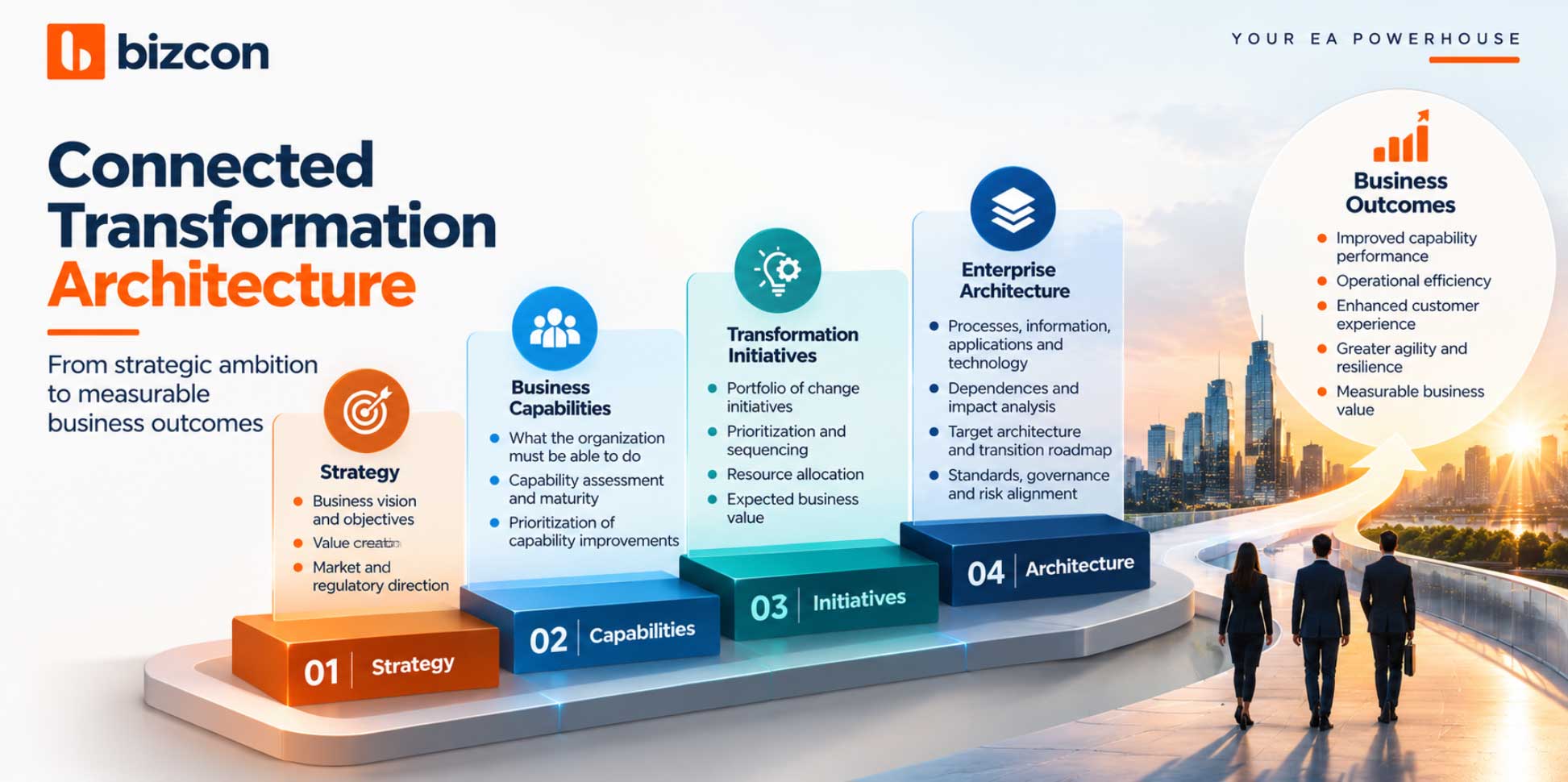
A connected transformation model should link:
Business Strategy & Objectives → Business Capabilities → Value Streams & Processes → Transformation Initiatives → Data, Applications & Technology → Risks & Controls → Business Outcomes
This creates a common structure for evaluating investments and managing change.
What does this enable?
Strategic alignment
Each initiative can be assessed against the business objectives and capabilities it supports.
Portfolio visibility
Leaders gain a clearer view of ongoing initiatives, overlapping investments, dependencies, and potential conflicts.
Investment prioritization
Resources can be directed toward initiatives with the strongest strategic relevance and expected business impact.
Impact analysis
Proposed changes can be evaluated across business processes, information, applications, technology, and governance requirements.
Outcome measurement
Organizations can connect completed initiatives to capability improvements and business results.
This approach also strengthens collaboration between business leadership, Enterprise Architects, portfolio managers, technology teams, and governance functions.
Instead of managing strategy, architecture, and delivery as separate activities, organizations can coordinate them through a shared transformation model.
Traditional technology roadmaps often describe a planned sequence of investments over several years.
They are useful for communicating direction, coordinating dependencies, and planning resources.
However, fixed roadmaps can become difficult to maintain when business priorities, technologies, and regulatory expectations change.
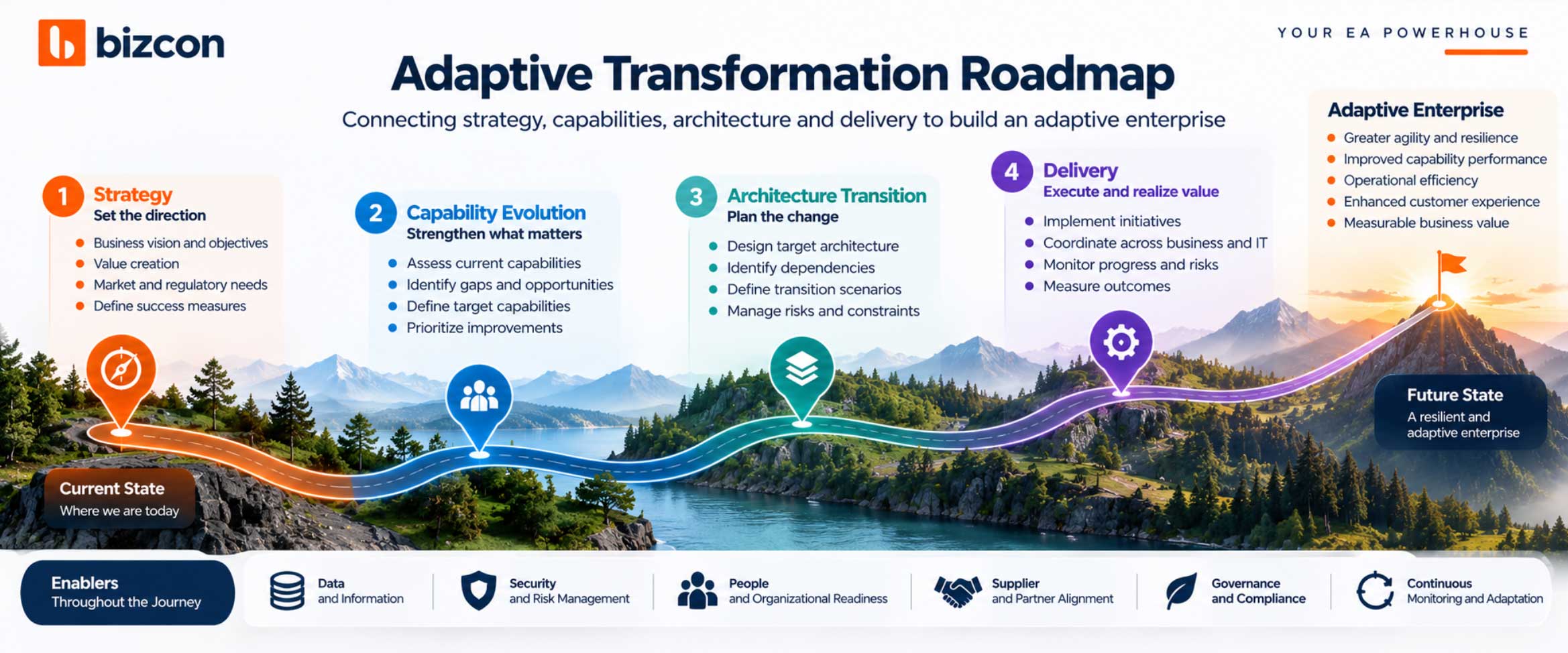
An adaptive enterprise requires roadmaps that are both strategically grounded and continuously reviewed.
An adaptive transformation roadmap should connect four dimensions:
Roadmaps should also account for architectural dependencies, technical debt, security requirements, supplier constraints, and organizational readiness.
Rather than becoming a static commitment to a predetermined technical solution, the roadmap should support informed adjustments as circumstances change.
This does not mean changing direction continuously.
It means preserving strategic intent while allowing the organization to adapt how it achieves its objectives.
Key Insight: A successful transformation roadmap provides direction without eliminating flexibility. It connects long-term business ambitions with the ability to respond to emerging opportunities and risks.
Organizations often make transformation decisions based on assumptions about future market conditions, technology developments, and business requirements.
But these assumptions may change.
Scenario planning helps decision-makers explore alternative futures and understand how different conditions could affect the enterprise.
Enterprise Architecture supports this by making dependencies and potential impacts more visible.
For example, organizations may need to consider:
By connecting scenarios with business capabilities, processes, information, applications, and technology, organizations can assess alternative transformation paths.
This enables leaders to compare options before committing significant resources.
Scenario-based planning can improve:
The objective is not to predict the future with certainty.
It is to develop the visibility and flexibility required to make informed decisions under uncertainty.
AI introduces significant opportunities for improving decision-making, automating activities, enhancing customer experiences, and developing new business capabilities.
However, AI also introduces new dependencies, risks, and governance requirements.
As explored in Part 3 of this series, responsible AI adoption requires visibility, accountability, risk management, data governance, and continuous monitoring.
These requirements should not exist separately from the wider transformation model.
AI initiatives should be connected to the same strategic, architectural, and portfolio structures used to manage other enterprise changes.
A connected approach to AI transformation should answer:
By embedding these questions into transformation planning, organizations can reduce the risk of disconnected AI experimentation.
AI becomes part of a coordinated enterprise capability rather than a collection of isolated technical solutions.
The goal is not simply to introduce more AI. It is to introduce the right AI capabilities, in the right business context, with appropriate governance and measurable outcomes.
Continuous transformation does not automatically produce a simpler enterprise.
Without coordinated architectural oversight, successive initiatives can introduce overlapping applications, redundant integrations, inconsistent data structures, and growing technical debt.
These challenges can reduce agility and increase operational costs.
An adaptive enterprise therefore needs to balance innovation with architectural sustainability.
Enterprise Architecture can support this by identifying:
Application portfolio management and technology lifecycle management are particularly important in this context.
They help organizations understand not only what new technology should be introduced, but also what existing technology should be improved, consolidated, or removed.
Sustainable transformation requires managing what the enterprise already has, not only what it plans to introduce.
Moving toward an adaptive enterprise requires more than architecture models and roadmaps.
It requires an operating model that connects strategic planning, architectural assessment, investment decisions, delivery, and performance monitoring.
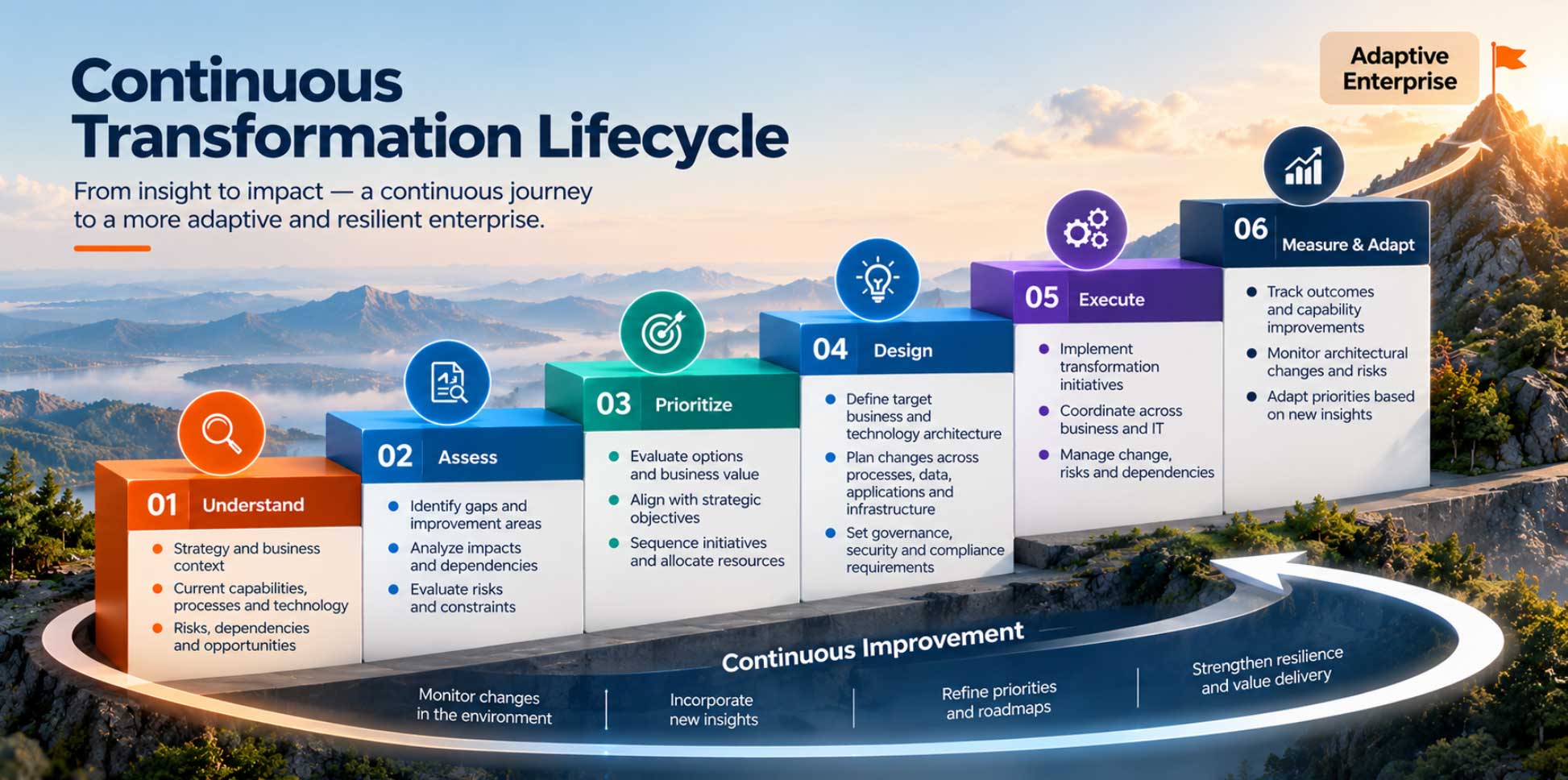
A practical continuous transformation model can be organized around six recurring activities.
Step 1 – Understand
Maintain visibility into the enterprise’s strategy, capabilities, processes, information, applications, technology, risks, and transformation portfolio.
Step 2 – Assess
Identify capability gaps, emerging business needs, architectural constraints, risks, and opportunities for improvement.
Step 3 – Prioritize
Evaluate transformation opportunities against strategic objectives, expected business value, dependencies, risk exposure, and available resources.
Step 4 – Design
Define the required business, process, data, application, and technology changes, including transition architectures and implementation roadmaps.
Step 5 – Execute
Coordinate transformation initiatives across business and technology teams, ensuring appropriate architectural governance and accountability.
Step 6 – Measure and Adapt
Monitor business outcomes, capability improvements, architecture changes, risks, and emerging requirements.
Use these insights to refine priorities and update transformation roadmaps.
Understand → Assess → Prioritize → Design → Execute → Measure & Adapt
This cycle should be supported by clear ownership, collaborative governance, and consistent information across the organization.
The aim is to make transformation a repeatable management capability rather than a sequence of disconnected initiatives.
An adaptive enterprise should measure success through business outcomes, not only project completion.
Delivering an application on time or implementing a technology platform within budget does not automatically demonstrate business value.
Organizations should consider a combination of strategic, operational, architectural, and governance indicators.
Measurement Area | Example Indicators |
Strategic alignment | Percentage of transformation initiatives linked to defined strategic objectives |
Business capability improvement | Changes in capability maturity, effectiveness, or performance |
Operational efficiency | Process cycle time, automation benefits, error reduction |
Architecture effectiveness | Application redundancy, technical debt, integration complexity |
Transformation delivery | Initiative progress, dependency resolution, realization of planned benefits |
Risk and governance | Control effectiveness, compliance findings, unresolved architecture risks |
Business outcomes | Customer satisfaction, service quality, cost efficiency, revenue contribution |
Not every organization needs to measure every indicator.
The appropriate measures depend on business objectives, organizational maturity, and available information.
What matters is establishing a clear connection between transformation investments and the outcomes they are expected to deliver.
This allows leadership to understand where transformation is creating value and where corrective action may be required.
Continuous transformation cannot be owned by Enterprise Architecture alone.
It requires collaboration across business leadership, strategy, portfolio management, technology, data governance, risk management, and operational teams.
Each function contributes a different perspective.
Business leadership defines strategic priorities and expected outcomes.
Business Architecture connects objectives with capabilities, value streams, and operating models.
Enterprise Architecture provides visibility into dependencies, transition requirements, and architectural impacts.
Portfolio Management coordinates investment priorities, delivery sequencing, and resource allocation.
Technology and AI teams design and implement the solutions required to support business change.
Data Governance ensures that information remains reliable, accessible, secure, and appropriately managed.
Risk, Security, and Compliance establish the controls needed to support responsible and resilient transformation.
The value emerges when these disciplines operate through connected information and coordinated decision-making.
A shared architectural view helps teams understand how their decisions affect the wider enterprise.
This reduces organizational silos and strengthens the ability to respond collectively to change.
At Bizcon, we see Enterprise Architecture as an important foundation for connecting strategic ambition with practical execution.
Organizations increasingly need to understand not only their current architecture, but also how their business capabilities, processes, information, applications, and technology must evolve.
This requires a connected approach to transformation planning and governance.
Together, these disciplines can help organizations make more informed transformation decisions and maintain alignment as business needs evolve.
The objective is not architecture for its own sake.
It is to use architecture as a practical management capability that supports business agility, investment transparency, resilience, and sustainable transformation.
Looking Ahead: Transformation as a Continuous Business Capability
The organizations best positioned for the future will not necessarily be those implementing the greatest number of technologies.
They will be those capable of understanding change, evaluating its impact, making informed investment decisions, and continuously adapting their business capabilities.
Enterprise Architecture can provide the foundation for this capability by connecting strategy with execution and enabling visibility across the enterprise.
But the real value comes when architectural insight is embedded into everyday business and technology decisions.
This is how organizations can move beyond individual transformation projects toward a more adaptive and resilient enterprise.
The next stage of enterprise transformation is not simply about managing change. It is about building the organizational capability to change continuously, responsibly, and with purpose.
Measuring Transformation Success: Turning Architecture, AI, and Digital Investments into Business Value
In the final part of our Executive Insights series, we will explore how organizations can connect transformation investments with measurable business outcomes, establish meaningful performance indicators, and demonstrate the value of Enterprise Architecture, AI, and digital transformation initiatives.
Bizcon Insight
Transformation is not a destination. It is an enterprise capability.
By connecting business strategy, capabilities, Enterprise Architecture, technology roadmaps, governance, and measurable outcomes, organizations can create a stronger foundation for continuous improvement and responsible innovation.